

DNA-based species identification has moved out of research labs and into routine work. Food-authenticity testing, herbal and supplement QC, microbial isolate identification and environmental DNA surveys all rely on it to answer a deceptively simple question: what organism is this?
The common approach is just as simple: sequence a marker gene, run BLAST, report the top hit. It works most of the time. The trouble is that the cases where it fails are often the ones where the answer matters most.
Why the answer matters
Seafood is the textbook example. Studies using DNA barcoding have repeatedly found species substitution in the supply chain — one survey of restaurants in Washington, D.C. found roughly a third of the sampled seafood was mislabelled. The same questions come up for meat, spices, botanicals and supplements, and for any lab that has to defend a result to a regulator, a customer or a court.
Three ways the top hit misleads
- The reference is wrong. Public databases contain mislabelled, contaminated and low-quality records. If the best match is itself misidentified, your result inherits the error.
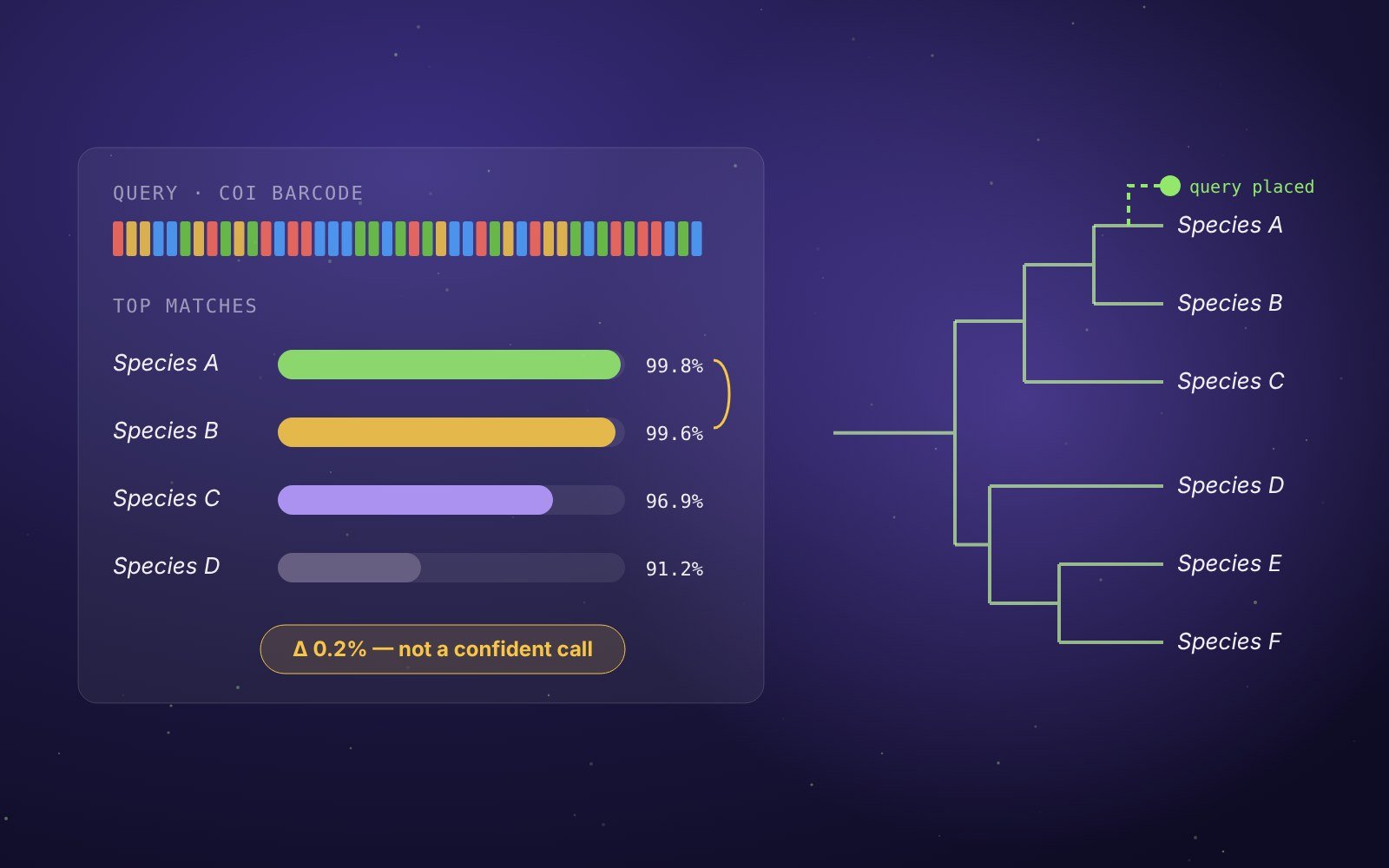
- The marker can’t separate the species. Closely related species can share identical or near-identical barcode sequences. A 99.8% match to one species and 99.6% to another is not a confident call — it’s a tie.
- The sample isn’t one organism. Processed foods, supplements and environmental samples often contain DNA from several species. Single-specimen barcoding reports only the dominant one.
The question isn’t “what is the best match?” It’s “how sure are we, and what else could it be?”
Choose the marker for the organism, not out of habit
No barcode works for everything. COI is the standard for most animals, ITS for fungi, rbcL and matK for plants, and 16S rRNA for bacteria — although 16S often can’t resolve closely related bacterial species, where whole-genome comparisons such as average nucleotide identity (ANI) are far more reliable. For mixed samples, metabarcoding detects multiple species at once. Choosing a method that can actually separate the candidates is the first step to a defensible answer.
Curate and version the reference
We treat the reference database as part of the method, not a given. Sequences are filtered for known mislabels, short or low-quality records and duplicates, and the curated set is versioned — so a result reported today can be reproduced next year, even after the public databases have changed underneath it.
Report confidence, not just a name
A defensible identification report includes:
- Percent identity and query coverage for the top match.
- The runner-up species, and how far behind it sits.
- Phylogenetic placement when similarity alone is ambiguous.
- An explicit “genus level only” or “not resolvable with this marker” result when that is the honest answer.
A report built this way takes slightly longer to read. It also holds up when someone challenges it — which, in authentication and compliance work, is exactly when it needs to. That’s the standard we apply in our Species Identification service.