

Single-Cell RNA Sequencing
Single-cell RNA-seq pipelines from raw barcoded reads to annotated cell populations — with empty droplets, doublets and batch effects removed before anyone starts naming clusters.
TYPICAL CLIENT
A lab that needs to know which cells are changing, not just which genes
Usually a PI, translational scientist or computational biologist in immunology, oncology, neuroscience or developmental biology working with 10x Genomics or plate-based data across several samples, who needs cell types and differential results they can defend in review — not clusters that shift every time the analysis is rerun.
Six concrete deliverables, not a slide deck.
This is exactly what transfers to you at the end of this Single-Cell RNA Sequencing engagement.
Demultiplexing & count matrices
Raw reads processed into per-sample cell-by-gene matrices with cell calling, barcode and UMI QC.
Cell QC with doublet & ambient removal
Low-quality cells filtered on transparent thresholds, doublets flagged and ambient RNA contamination corrected.
Batch-aware integration
Samples integrated across batches and donors without washing out real biological differences.
Clustering & cell-type annotation
Reproducible clustering with reference-based and marker-based annotation, documented cluster by cluster.
Pseudobulk differential expression
Condition comparisons run at the sample level within each cell type, so p-values reflect biological replicates, not cell counts.
Full documentation & handoff session
Written documentation plus a recorded walkthrough so your team can operate the pipeline independently.
What this service includes
Count matrix generation
Barcode, UMI and cell calling from raw FASTQs through to filtered count matrices.
Cell & doublet QC
Mitochondrial fraction, gene counts, doublet detection and ambient RNA correction.
Integration & clustering
Batch correction, dimensionality reduction and stable clustering across samples.
Annotation & differential testing
Cell-type labels with evidence, plus pseudobulk differential expression between conditions.
What this looks like in a real engagement
Three concrete examples of the kind of work this service covers.
Tumour microenvironment profiling
Immune, stromal and malignant compartments resolved and compared between responders and non-responders.
Developmental trajectory analysis
Pseudotime and RNA velocity used to order cells along differentiation paths.
Multi-donor atlas integration
Dozens of samples from different donors and batches combined into one consistently annotated reference.
Why a UMAP that looks clean can still hide the wrong answer.
Single-cell data has failure modes bulk data doesn’t: empty droplets counted as cells, doublets that look like novel cell states, ambient RNA that blurs markers, and batch effects that masquerade as biology. Differential tests run cell-by-cell also inflate significance by treating thousands of cells as independent replicates.
We build scRNA-seq pipelines that remove these artifacts explicitly and test conditions at the sample level, so the cell types and differences you report are ones that reproduce.
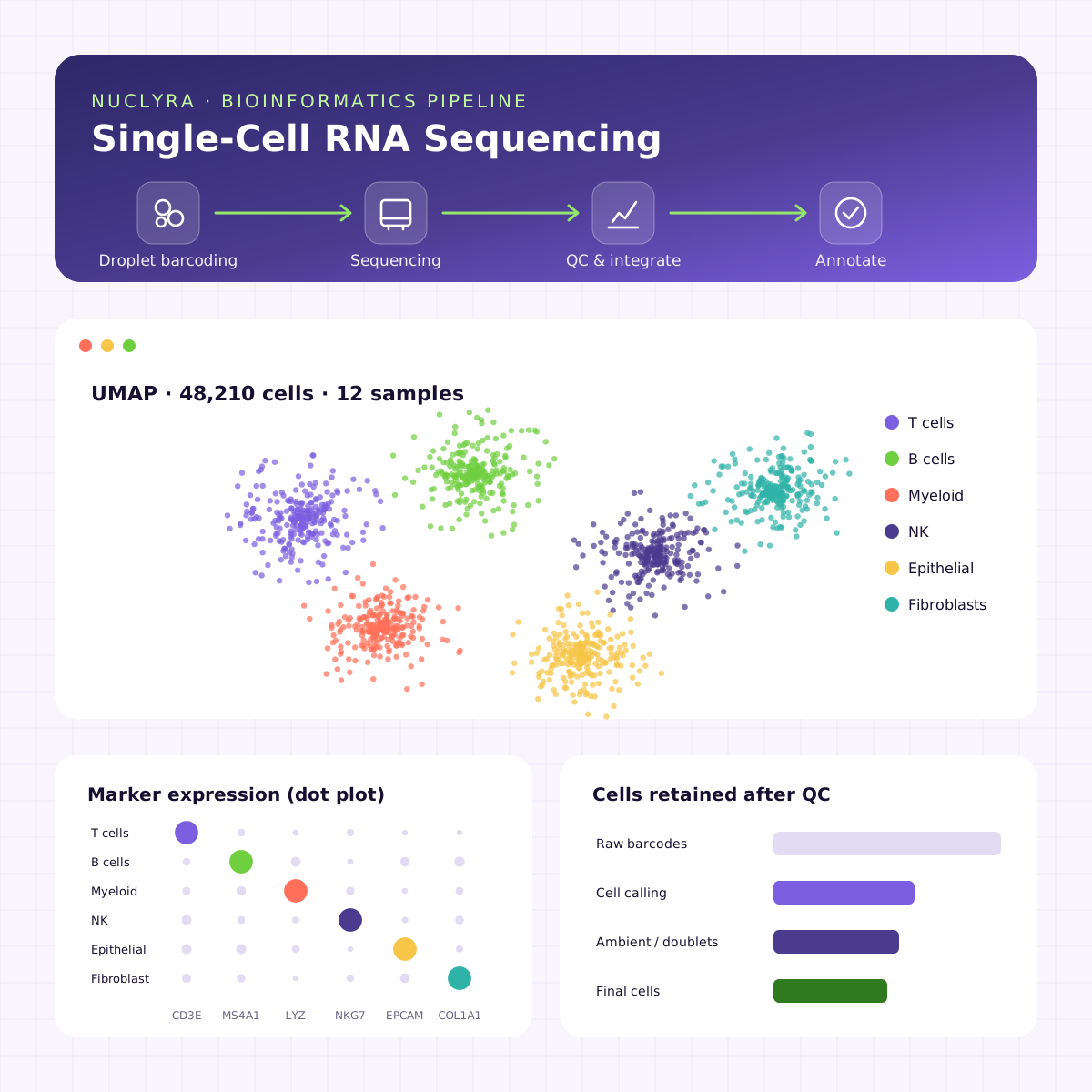
How an engagement runs
Four stages, from sample intake to delivery.
Demultiplex & count
Barcoded reads are demultiplexed, aligned and collapsed into cell-by-gene count matrices.
Cell, doublet & ambient QC
Low-quality cells, doublets and ambient RNA are removed on documented thresholds.
Integrate & cluster
Samples are batch-corrected, clustered and annotated with marker and reference evidence.
Test & hand off
Pseudobulk differential expression is run per cell type, then documented and delivered.
What we build it with
A cluster is a hypothesis about cell identity — the evidence behind it should travel with it.
Before you reach out
10x Genomics (3′, 5′, Flex and Multiome), Parse, Scale and plate-based protocols such as Smart-seq — tell us your chemistry and we’ll confirm the processing path.
Yes. We can start from filtered or raw count matrices, though raw matrices let us apply our own cell calling and ambient RNA correction.
We combine reference-based annotation with canonical marker review, and every label is documented with the evidence behind it so your team can challenge or refine it.
Explore related work
Total RNA-Sequencing
Bulk transcriptome profiling when tissue-level expression is the right resolution.
View ATACATAC Sequencing
Add chromatin accessibility to explain the expression changes you see.
View BIOBioinformatics Pipeline overview
See how single-cell RNA sequencing fits into the full Bioinformatics Pipeline service.
ViewHave single-cell data waiting on cell types you can defend?
Send us your chemistry, sample count and study design — we’ll tell you honestly what comparisons your data can support.