
DNA Methylation (Bisulfite / EM-seq)
DNA methylation pipelines for bisulfite and enzymatic (EM-seq) libraries — from converted reads to per-CpG methylation calls and differentially methylated regions, with conversion efficiency verified at every step.
TYPICAL CLIENT
A lab measuring how methylation changes between disease, treatment or development states
Usually a PI or computational biologist in cancer epigenetics, ageing, developmental biology or plant genomics running WGBS, RRBS, EM-seq or targeted methylation panels, who needs CpG-level calls and differential regions that account for coverage, conversion efficiency and biological replication.
Six concrete deliverables, not a slide deck.
This is exactly what transfers to you at the end of this DNA Methylation engagement.
Conversion-aware alignment
Reads aligned to an in-silico converted genome with protocol-specific trimming for WGBS, RRBS or EM-seq libraries.
Conversion efficiency & M-bias QC
Bisulfite or enzymatic conversion rates, M-bias and coverage reported per sample before calls are trusted.
Per-CpG methylation calls
Methylation levels and coverage per CpG (and CHG/CHH where relevant) in standard, reusable formats.
Differentially methylated regions
DMR and DMC detection between conditions with coverage filters and replicate-aware statistics.
Annotation to genes & regulatory features
Differential regions mapped to promoters, CpG islands, shores and enhancers for interpretation.
Full documentation & handoff session
Written documentation plus a recorded walkthrough so your team can operate the pipeline independently.
What this service includes
Conversion-aware alignment
Protocol-specific trimming and alignment against converted reference genomes.
Conversion & bias QC
Conversion efficiency, M-bias, duplication and CpG coverage checked for every library.
Methylation calling
Per-cytosine methylation levels with coverage, in CpG and non-CpG contexts.
DMR & annotation
Differentially methylated regions called and annotated to genes and regulatory elements.
What this looks like in a real engagement
Three concrete examples of the kind of work this service covers.
Tumour vs normal methylomes
Whole-genome methylation compared across matched samples to find promoter hypermethylation and global hypomethylation.
EM-seq for low-input samples
Enzymatic conversion data from limited or degraded DNA processed without the fragmentation bias of bisulfite.
Targeted panel & RRBS studies
Cost-efficient CpG-island-focused designs analysed across large sample cohorts.
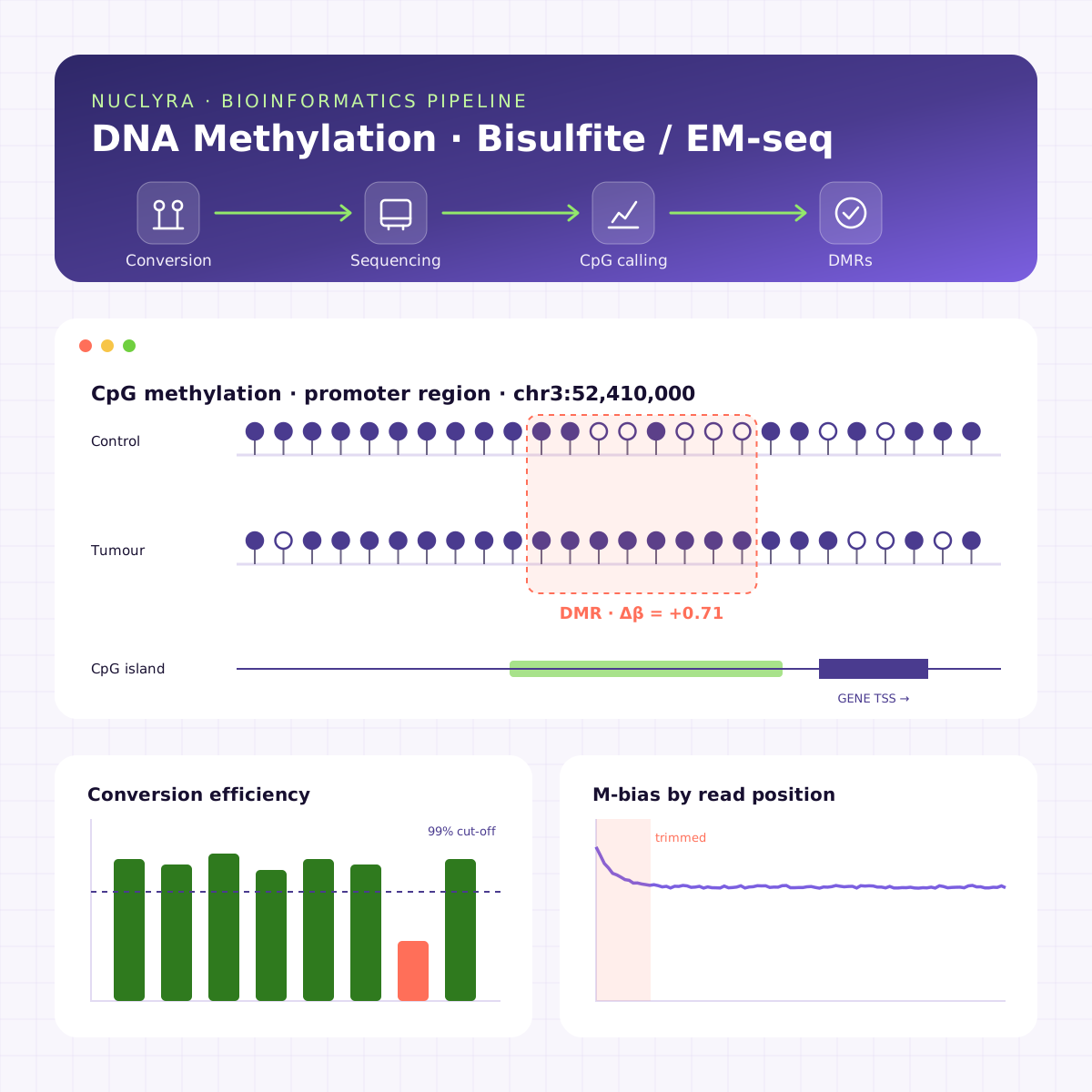
Why a methylation call is only as reliable as its conversion.
Incomplete conversion makes unmethylated cytosines look methylated, and end-repair bias at read ends can shift levels systematically. Low-coverage CpGs produce extreme values that dominate naive differential tests. None of this is visible in a summary table unless someone looks for it.
We build methylation pipelines that measure conversion efficiency and M-bias for every library, filter on coverage before testing, and model replicates properly — so a differentially methylated region reflects biology, not chemistry.
How an engagement runs
Four stages, from sample intake to delivery.
Convert-aware alignment
Reads are trimmed for the protocol and aligned against converted reference genomes.
Conversion & M-bias QC
Conversion efficiency, M-bias and CpG coverage are verified before calling.
Methylation & DMR calling
Per-CpG levels are extracted and tested for differential methylation between groups.
Annotate & hand off
Regions are annotated to genomic features, documented and delivered.
What we build it with
If you haven’t measured conversion, you haven’t measured methylation.
Before you reach out
EM-seq causes less DNA damage and gives more even coverage, especially for low-input samples; bisulfite is well established and cheaper per sample. We can advise based on your input amounts and study goals.
Standard bisulfite and EM-seq measure both together. If you need to separate them, we can process oxBS-seq, TAB-seq or long-read methylation data alongside your standard libraries.
Yes — array data can be processed with established normalization pipelines and compared or integrated with sequencing-based results.
Explore related work
Long-Read Sequencing (ONT / PacBio)
Native methylation calls straight from long reads, with no conversion step.
View WGSWhole Genome Sequencing
Genetic variation alongside the epigenetic layer from the same samples.
View BIOBioinformatics Pipeline overview
See how DNA methylation sequencing fits into the full Bioinformatics Pipeline service.
ViewHave methylation data waiting on regions you can trust?
Send us your protocol, input amounts and study design — we’ll tell you honestly whether your coverage supports the comparisons you need.