
Whole Genome Sequencing
End-to-end WGS pipelines that take raw FASTQ to annotated, QC’d variant calls across the entire genome — built to catch the structural and regulatory-region variants a targeted panel would miss.
TYPICAL CLIENT
A genomics lead who needs full-genome coverage, not just the exons
Usually a Head of Genomics, clinical geneticist or research PI investigating a rare disease, cancer or population cohort where the causal variant could sit anywhere in the genome — including structural variants and regulatory regions a panel or exome would never see.
Six concrete deliverables, not a slide deck.
This is exactly what transfers to you at the end of this Whole Genome Sequencing engagement.
Containerized germline & somatic pipeline
A versioned Nextflow pipeline built on GATK best-practices, delivered as code your team can run independently.
Alignment & coverage QC reports
Per-sample QC covering depth, coverage uniformity, duplication rate and Ts/Tv ratio, flagged before results reach a researcher.
Annotated, filtered VCFs
Variant calls annotated against ClinVar, gnomAD and functional consequence, with a documented filtering rationale.
Structural variant & CNV calling module
A dedicated SV/CNV detection step, since large rearrangements are exactly what whole genome sequencing is meant to catch.
Benchmark against GIAB truth sets
Precision and recall reported against Genome in a Bottle reference samples, so accuracy claims are independently checkable.
Full documentation & handoff session
Written documentation plus a recorded walkthrough so your team can operate the pipeline independently.
What this service includes
High-accuracy alignment
Reads aligned with BWA-MEM2 or DRAGEN-equivalent open tooling, tuned for whole-genome throughput.
Germline & somatic variant calling
GATK and DeepVariant-based calling, with a tumor-normal mode for somatic work.
Structural variant & CNV detection
A dedicated module for large insertions, deletions, translocations and copy-number changes.
Clinical-grade annotation
Variants annotated and filtered against ClinVar, gnomAD and consequence predictors before delivery.
What this looks like in a real engagement
Three concrete examples of the kind of work this service covers.
Rare disease trio WGS
Proband and parent genomes analyzed together to narrow a de novo or inherited causal variant across the full genome.
Tumor-normal oncology WGS
Paired tumor and normal samples processed to call both somatic point mutations and structural rearrangements.
Population-scale cohort WGS
A pipeline scaled to process hundreds of genomes with consistent QC gates and joint genotyping.
Why the whole genome, and not just the coding 2%.
Exome sequencing captures protein-coding regions well, but most structural variants, regulatory-region changes and non-coding disease associations sit outside that 2%. A pipeline that only looks at exons will never find them, no matter how good its variant caller is.
We build WGS pipelines that treat the whole genome as the search space it actually is — with QC gates and benchmarking against known-answer samples, so a negative result means the variant genuinely isn’t there, not that the pipeline didn’t look.
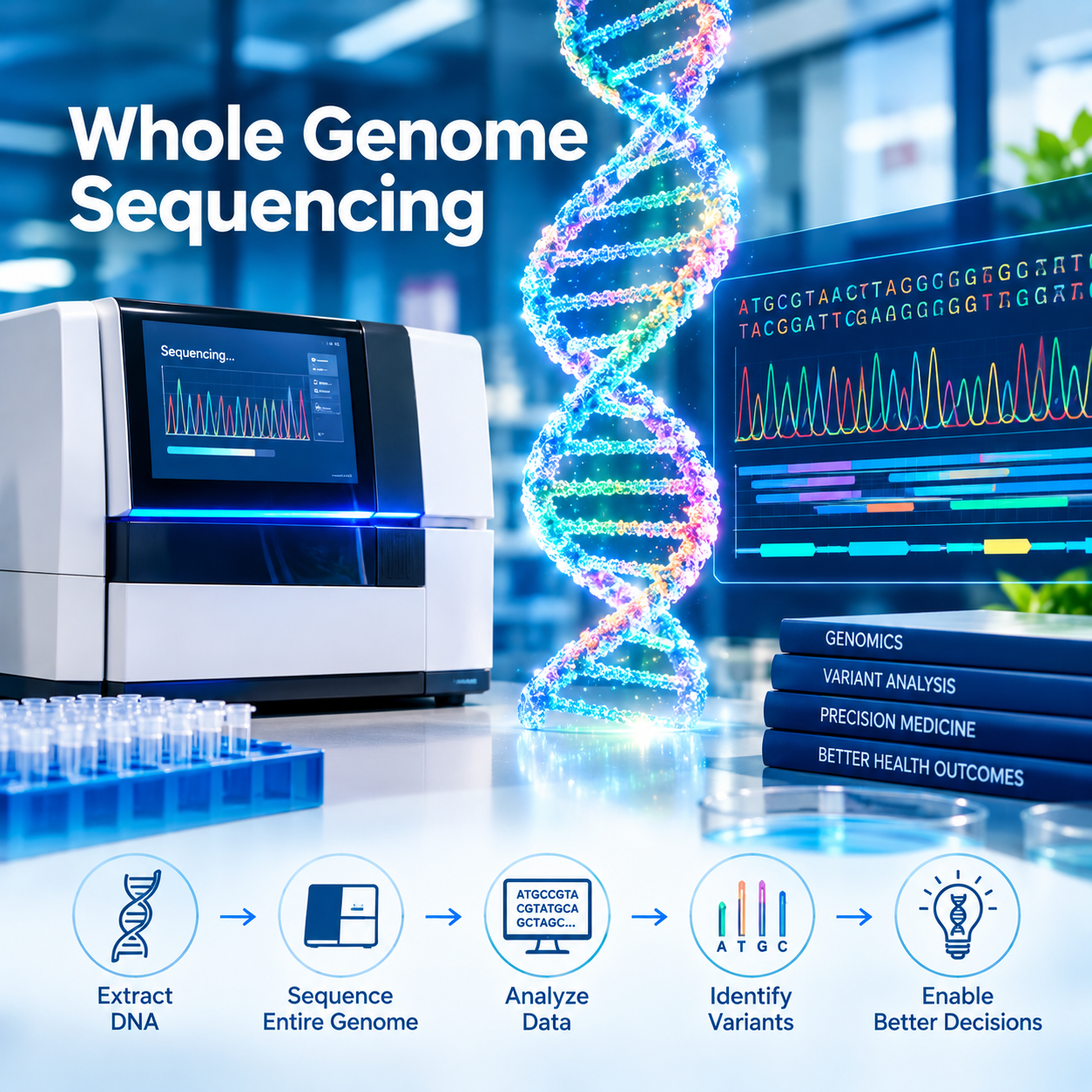
How an engagement runs
Four stages, from sample intake to delivery.
Sample & QC intake
Raw FASTQ files are checked for quality, coverage and contamination before any alignment starts.
Alignment & variant calling
Reads are aligned genome-wide and germline or somatic variants are called against the reference.
Annotation & filtering
Variants are annotated, filtered and prioritized against clinical and population databases.
Benchmark & hand off
Results are benchmarked against a known-answer sample, documented and transferred to your team.
What we build it with
A whole genome that only gets read as far as the exons isn’t really a whole genome sequencing result.
Before you reach out
30× is standard for germline work; tumor-normal somatic analysis typically needs 60–100× on the tumor sample to reliably call low-frequency variants.
Yes. GRCh38 is our default reference, with T2T-CHM13 available for projects that need the more complete assembly, particularly around repetitive regions.
Yes — SV and CNV calling is a standard module alongside SNV/indel calling, not a separate add-on.
Explore related work
Total RNA-Sequencing
Pair genomic variant calls with expression data to see which variants actually affect transcription.
View WESWhole Exome Sequencing
A cost-efficient alternative when the coding regions are genuinely all you need.
View BIOBioinformatics Pipeline overview
See how whole genome sequencing fits into the full Bioinformatics Pipeline service.
ViewHave a genome you need read in full?
Send us your sequencing goals and sample type — we’ll tell you honestly what depth and pipeline design you actually need, and what it would take to deliver it.