

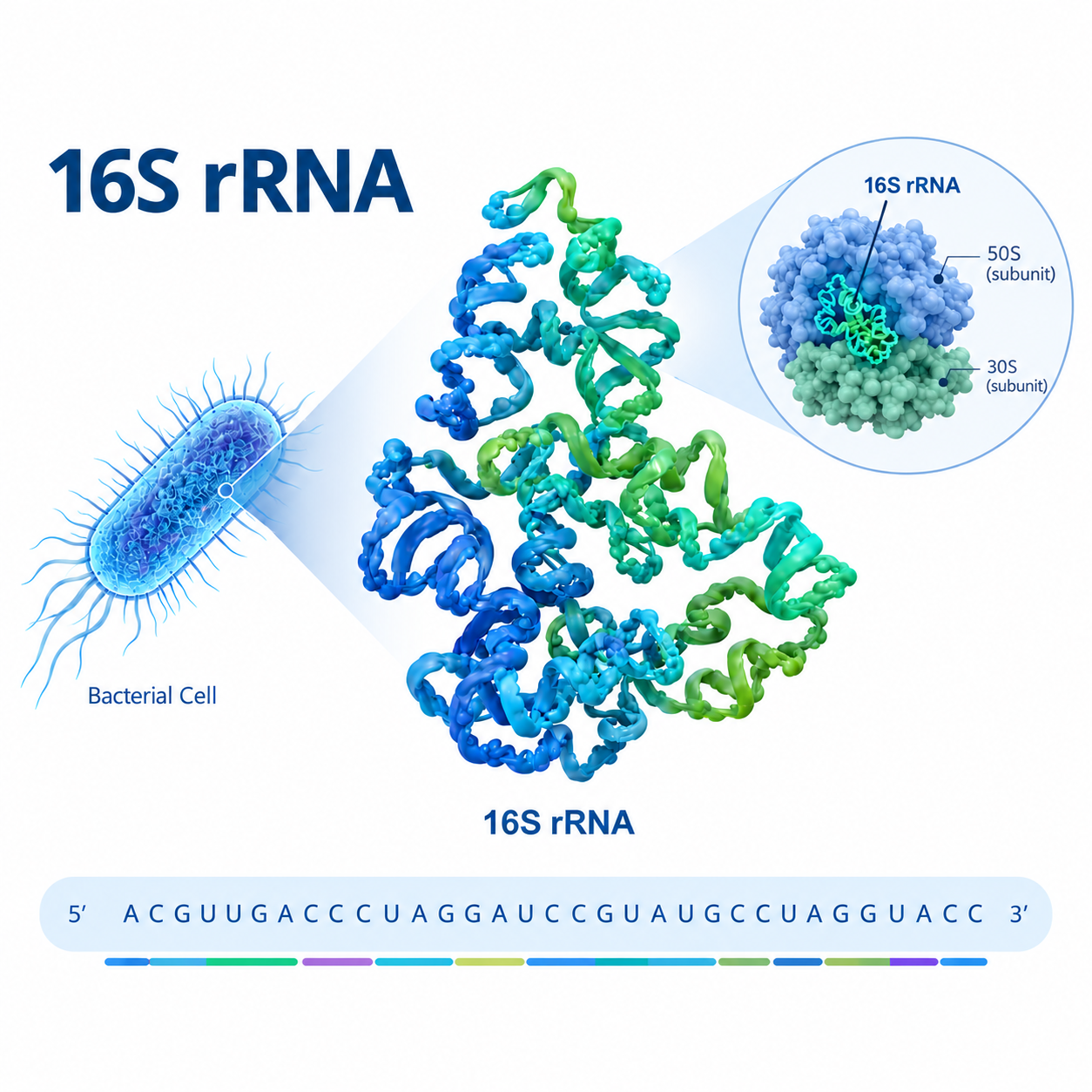
16S rRNA
16S rRNA amplicon pipelines for microbial community profiling — from raw reads to taxonomy, diversity metrics and publication-ready figures.
TYPICAL CLIENT
A lab that needs fast, cost-effective community composition, not full functional profiling
Usually a microbiome researcher, clinical microbiologist or environmental scientist who needs a reliable read on bacterial community composition across many samples, without the cost or turnaround time of shotgun sequencing.
Six concrete deliverables, not a slide deck.
This is exactly what transfers to you at the end of this 16S rRNA engagement.
Primer trimming & quality filtering
Reads trimmed to your primer set and quality-filtered before any taxonomic inference.
ASV inference
Amplicon sequence variants inferred with DADA2 or QIIME2, giving exact sequence resolution instead of clustered OTUs.
Taxonomic classification
ASVs classified against a curated 16S reference database down to the finest resolvable taxonomic level.
Alpha & beta diversity analysis
Within- and between-sample diversity metrics with ordination plots for group comparison.
Differential abundance testing
Statistical testing to identify taxa that differ significantly between your defined sample groups.
Full documentation & handoff session
Written documentation plus a recorded walkthrough so your team can operate the pipeline independently.
What this service includes
Primer-aware quality filtering
Reads trimmed and filtered against your specific 16S primer set and target hypervariable region.
ASV inference (DADA2/QIIME2)
Exact amplicon sequence variants inferred instead of coarser OTU clustering, for finer taxonomic resolution.
Taxonomic classification
Classification against curated 16S databases (SILVA, Greengenes2) down to genus or species level where resolvable.
Diversity & statistical analysis
Alpha/beta diversity and differential abundance testing delivered as figures your team can use directly.
What this looks like in a real engagement
Three concrete examples of the kind of work this service covers.
Gut microbiome intervention study
Pre/post samples from a dietary or therapeutic intervention profiled for shifts in community composition.
Soil or environmental 16S survey
Environmental samples across sites or seasons profiled to characterize bacterial community differences.
Clinical dysbiosis screening
Patient samples screened for taxonomic markers associated with a defined clinical condition.
Why 16S is still the right first question for a lot of microbiome work.
Not every project needs shotgun-level functional resolution. When the question is “how does community composition differ between these groups,” 16S rRNA sequencing answers it quickly, at lower cost, and at a scale — hundreds of samples — that makes shotgun sequencing impractical.
We build 16S pipelines around ASV inference rather than older OTU clustering, so results are directly comparable across studies and reference databases without re-processing.
How an engagement runs
Four stages, from sample intake to delivery.
Primer trim & filter
Reads are trimmed to the primer set and quality-filtered before variant inference.
ASV inference
Amplicon sequence variants are inferred and a feature table is built across all samples.
Taxonomic classification
ASVs are classified against a curated reference database to the finest resolvable level.
Diversity analysis & hand off
Diversity statistics and comparison figures are generated, documented and delivered.
What we build it with
At species-comparison scale across hundreds of samples, 16S still gets you a reliable answer faster than shotgun ever will.
Before you reach out
V3–V4 is the most common choice for general bacterial profiling; we can advise based on your organism of interest and existing study comparability.
We use ASV inference by default (via DADA2) since it resolves exact sequence variants and stays comparable across studies, unlike similarity-clustered OTUs.
The pipeline is built for batch processing — we’ve run cohorts from a handful of samples up to several hundred in a single batch.
Explore related work
Shotgun Metagenomics
Step up to full functional and strain-level resolution when genus-level composition isn’t enough.
View RNATotal RNA-Sequencing
A complementary host-transcriptome view to pair with microbiome composition data.
View BIOBioinformatics Pipeline overview
See how 16S rRNA sequencing fits into the full Bioinformatics Pipeline service.
ViewHave a cohort waiting on a community composition answer?
Send us your sample count and study design — we’ll tell you honestly whether 16S gives you the resolution this study needs.