

Explainable AI Systems
Interpretability and documentation that let domain experts, clinicians and regulators see why a model made a call — not just what it predicted.
TYPICAL CLIENT
A team whose model can’t be adopted until someone can explain its decisions
Usually a compliance lead, medical director or research lead sitting on an accurate model that clinicians, auditors or reviewers won’t act on until they understand, in plain terms, why it reached a given conclusion.
Six concrete deliverables, not a slide deck.
This is exactly what transfers to you at the end of this engagement.
Feature attribution report
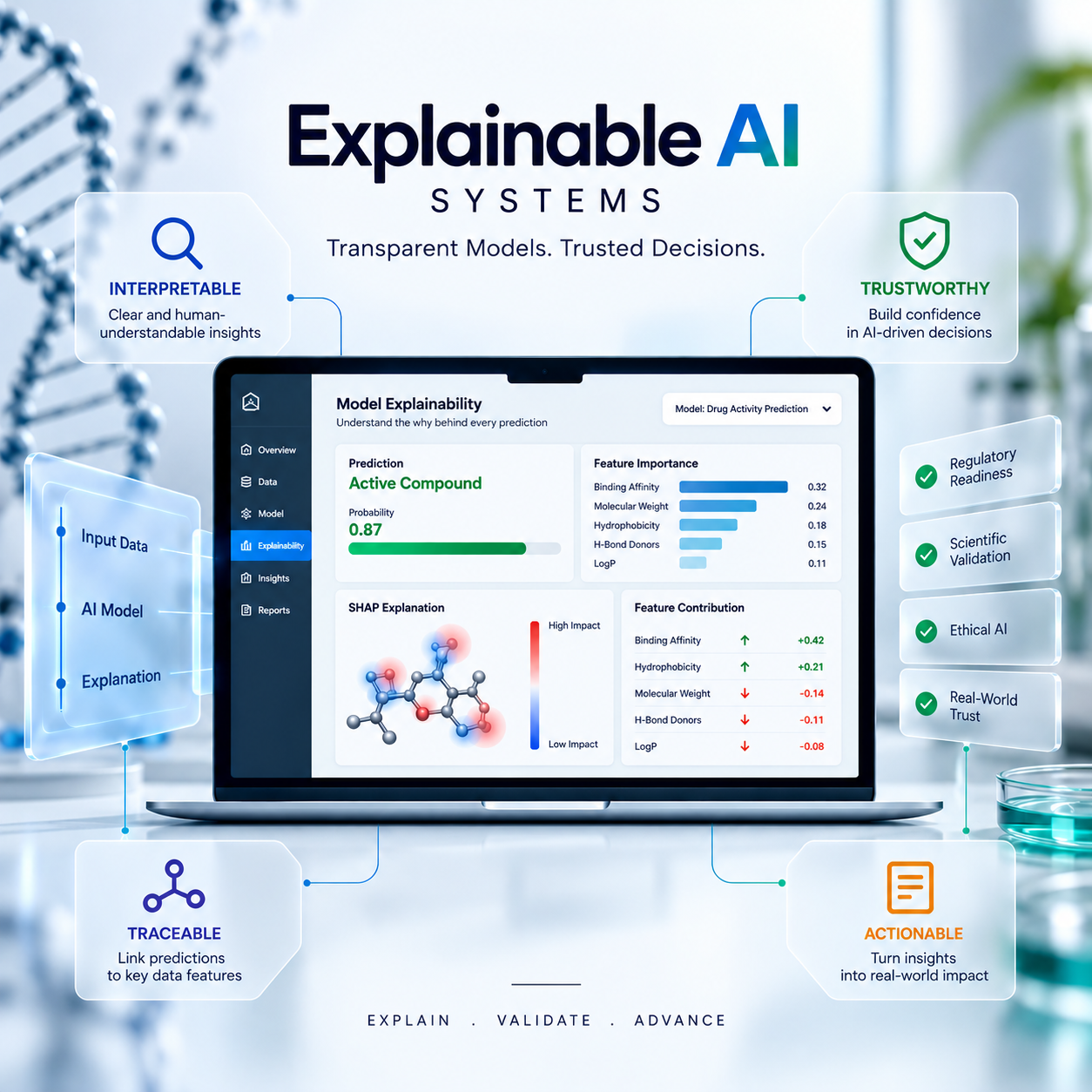
A SHAP- or LIME-based breakdown of which inputs drove each prediction, at both the global and individual-case level.
Model card
A standardized document covering intended use, known limitations, training data characteristics and performance boundaries.
Human-readable decision explanations
Explanation output built for the actual reviewer — a clinician, auditor or scientist — not a data scientist.
Bias & subgroup performance audit
Performance broken out across relevant subgroups, so disparities surface before deployment, not after.
Regulatory-ready interpretability documentation
Documentation packaged to the standard your submission or audit process requires.
Full source code for the explanation pipeline
The attribution and reporting code transfers to you, versioned alongside the model it explains.
What this service includes
Feature attribution & saliency
SHAP, LIME and gradient-based attribution methods matched to your model type and data modality.
Model cards & documentation
Structured, standardized documentation of intended use, limitations and performance boundaries.
Subgroup & bias auditing
Performance disaggregated across demographic or operational subgroups to catch disparities early.
Domain expert-facing reporting
Explanations translated into language and visuals a clinician or reviewer can actually use.
What this looks like in a real engagement
Three concrete examples of the kind of work this service covers.
Explaining a diagnostic classifier to reviewing clinicians
Per-case attribution reports that show clinicians which lab values and features drove a flagged result, before they act on it.
Model card for a regulatory-adjacent submission
A complete model card and interpretability packet prepared alongside a validation report for external review.
Bias audit across demographic subgroups
A subgroup performance audit for a triage model, surfacing where accuracy dropped for underrepresented groups in the training data.
Why an accurate model nobody can explain doesn’t get used.
In consumer software, a wrong recommendation is a minor inconvenience. In diagnostics, drug discovery or clinical operations, a model’s call has to be explainable to the person accountable for acting on it — or it simply won’t be used, however accurate it is.
We treat explainability as a deliverable in its own right: attribution, documentation and reporting built for the actual reviewer, so trust in the model doesn’t depend on trusting us.
How an engagement runs
Four stages, from initial scope to delivery.
Define who needs to trust it
We identify the actual reviewer — clinician, auditor, scientist — and what they need to see to act on a prediction.
Choose the interpretability method
Attribution and explanation methods are matched to your model architecture and data type.
Build the reporting layer
Attribution output is turned into reports or UI elements the reviewer can actually read and act on.
Validate with domain experts
Explanations are reviewed with real domain experts before rollout, not just checked for statistical soundness.
What we build it with
An accurate model nobody can explain doesn’t get adopted — it gets shelved.
Before you reach out
It depends on the model and data type — SHAP and LIME for tabular models, gradient-based attribution for deep learning, always validated against what your reviewers actually find useful.
Yes, where needed. We design the attribution pipeline to run alongside inference so explanations ship with every prediction, not as an offline afterthought.
We build to the standard your submission or audit process requires, and we’ll tell you upfront if additional validation work is needed to fully meet it.
Explore related work
Model Development & Validation
The model development and validation work that this explainability layer sits on top of.
View OPSMLOps for Regulated Environments
Keeping explanation and audit-trail infrastructure running once the model is in production.
View PRODUCTSentinel Audit
Our packaged tool for continuous model auditing and access oversight.
ViewHave a model nobody can explain yet?
Send us the model and the audience it needs to convince — we’ll tell you honestly what it takes to make it explainable.