

Total RNA-Sequencing
Total RNA-seq pipelines covering coding and non-coding transcripts alike — from raw reads to differential expression, without the polyA-selection blind spot.
TYPICAL CLIENT
A transcriptomics researcher who needs the whole transcriptome, not just mRNA
Usually a computational biologist or PI studying gene expression who needs visibility into non-coding and non-polyadenylated RNA — lncRNAs, histone mRNAs, degraded clinical samples — that a standard polyA-selected RNA-seq protocol would miss entirely.
Six concrete deliverables, not a slide deck.
This is exactly what transfers to you at the end of this Total RNA-Sequencing engagement.
rRNA-depletion aware QC & trimming
Quality control and adapter trimming tuned for rRNA-depleted libraries, which behave differently from polyA-selected data.
Alignment & quantification
Reads aligned with STAR and quantified with Salmon or featureCounts at both gene and transcript level.
Differential expression analysis
DESeq2-based differential expression between your defined sample groups, with multiple-testing correction applied.
Non-coding RNA annotation
lncRNAs and other non-coding transcripts specifically annotated, not just discarded as unmapped or ambiguous reads.
QC & MultiQC report
A consolidated QC report covering library complexity, rRNA content, strand specificity and alignment rates.
Full documentation & handoff session
Written documentation plus a recorded walkthrough so your team can operate the pipeline independently.
What this service includes
Alignment & quantification
STAR-based alignment paired with Salmon or featureCounts for accurate gene- and transcript-level quantification.
Differential expression analysis
DESeq2-based statistical testing with proper multiple-testing correction and effect size reporting.
Non-coding RNA detection
Dedicated annotation for lncRNAs and other non-coding transcripts that polyA-selected protocols would miss.
Pathway & GO enrichment
Differentially expressed gene sets tested for pathway and Gene Ontology enrichment to aid biological interpretation.
What this looks like in a real engagement
Three concrete examples of the kind of work this service covers.
Disease vs control transcriptome comparison
Differential expression analysis between disease and control cohorts to identify dysregulated genes and pathways.
lncRNA discovery study
A total RNA-seq dataset mined specifically for novel long non-coding RNAs associated with a phenotype.
Time-course expression profiling
Samples across a time series processed to trace expression trajectories through a biological process.
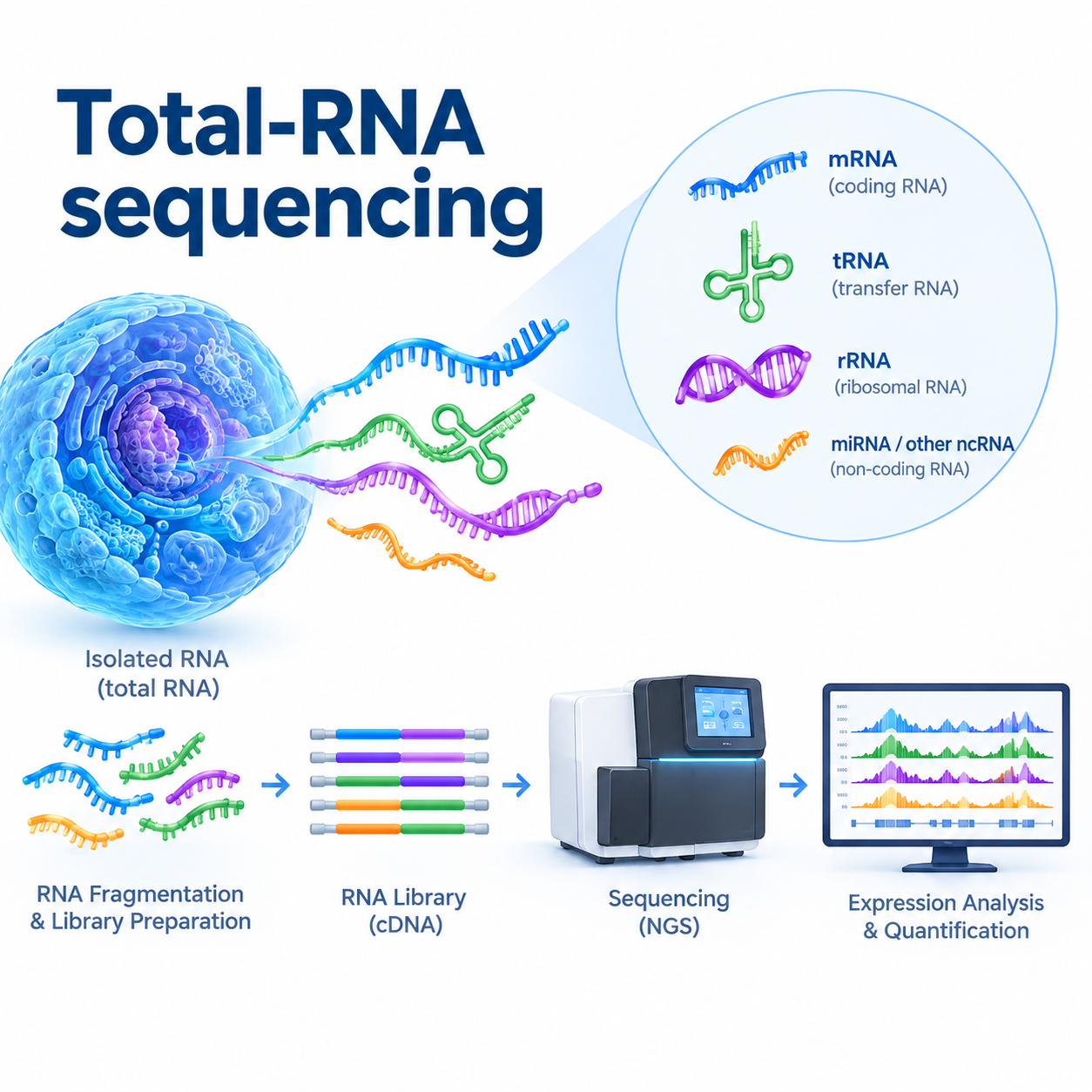
Why total RNA-seq sees transcripts polyA selection was designed to miss.
PolyA selection is efficient, but it systematically excludes histone mRNAs, many long non-coding RNAs, and degraded RNA typical of FFPE or clinical samples — all of which lack a stable polyA tail. If your biology lives in that space, a standard mRNA-seq protocol will simply never show it to you.
We build total RNA-seq pipelines around rRNA depletion instead of polyA selection, with QC and quantification steps specifically tuned for the different read composition that protocol produces.
How an engagement runs
Four stages, from sample intake to delivery.
QC & trimming
Reads are quality-checked and trimmed with parameters tuned for rRNA-depleted libraries.
Alignment & quantification
Reads are aligned and quantified at gene and transcript level, including non-coding transcripts.
Differential expression analysis
Expression is compared across your defined sample groups with statistical correction applied.
Enrichment & hand off
Pathway enrichment results are generated, documented and delivered with the full dataset.
What we build it with
If your transcript of interest doesn’t have a polyA tail, a standard mRNA-seq protocol was never going to find it.
Before you reach out
Whenever non-coding RNA, histone transcripts, or degraded samples (like FFPE) are relevant — polyA selection systematically misses all three.
Yes — quantification is delivered at both gene and transcript level, so isoform-level differences aren’t averaged away.
Yes — QC steps flag degradation and library complexity issues early, and analysis parameters are adjusted accordingly.
Explore related work
16S rRNA
A complementary microbiome-composition view to pair with host transcriptome data.
View WGSWhole Genome Sequencing
Pair expression data with genomic variant calls to see which variants affect transcription.
View BIOBioinformatics Pipeline overview
See how total RNA sequencing fits into the full Bioinformatics Pipeline service.
ViewHave RNA-seq data that needs the non-coding transcriptome too?
Send us your sample type and research question — we’ll tell you honestly whether total RNA-seq or standard mRNA-seq is the right protocol.