

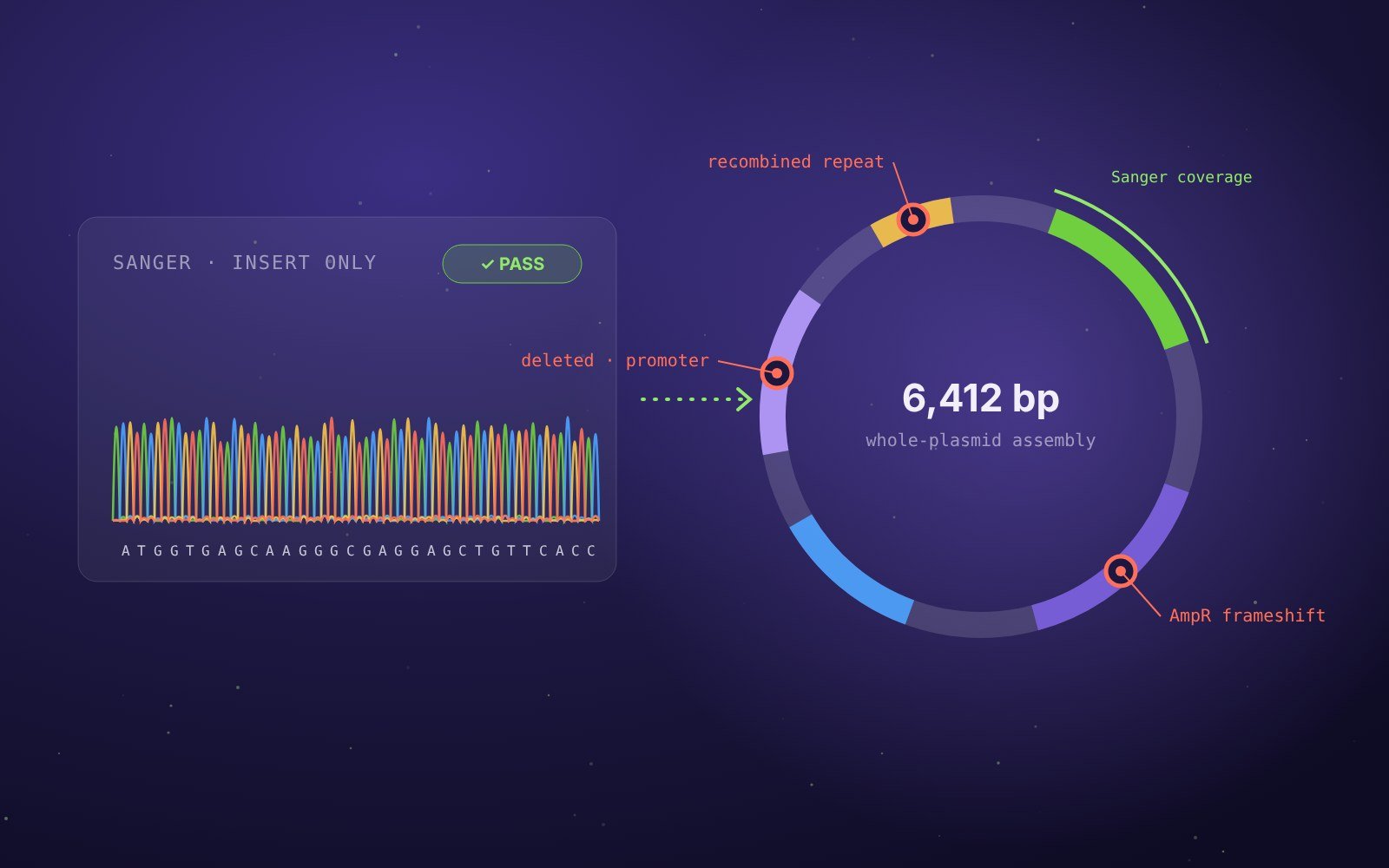
For years, verifying a clone meant a couple of Sanger reads across the insert. If the trace was clean and the insert matched the design, the construct was approved and the experiment moved on. That workflow made sense when sequencing the rest of the plasmid cost more than the experiment it was protecting. It doesn’t any more.
What the insert read never sees
A typical plasmid is several kilobases long; a single Sanger read reliably covers around 800 to 1,000 bases of it. Everything else — the backbone, selection marker, origin and regulatory elements — is assumed to be correct because it was correct in the parent vector. Most of the time, it is. The failures that slip through are the expensive ones.
- Mutations outside the insert. A point mutation in a promoter, a frameshift in a resistance gene that only matters once selection is applied, or a damaged polyA signal that quietly halves expression.
- Recombination in repeats. Direct and inverted repeats — AAV ITRs, lentiviral LTRs, tandem tags — are prone to rearrangement during propagation, and Sanger chemistry often struggles to read through them at all.
- Mixed populations. Two plasmids in one prep, a dimer alongside the monomer, or a minority clone carrying a deletion. A Sanger trace reports the majority sequence, and minor populations are easy to miss.
- Right insert, wrong backbone. A mix-up between similar parent vectors that leaves the insert perfect and everything around it wrong.
Why the economics changed
Long-read whole-plasmid sequencing, most commonly on Oxford Nanopore platforms, has made it routine to sequence the entire molecule for a price comparable to a handful of Sanger reads, often with results back in a day or two. Because individual reads typically span the full plasmid, a construct can be assembled de novo without primers or a reference.
That moves the bottleneck. Generating data is no longer the hard part — interpreting it consistently is, especially for a cloning core or synthetic biology team processing hundreds of clones a week.
Sequencing the whole plasmid is now cheap. Deciding, consistently, whether it’s the plasmid you designed is the part that still needs engineering.
Four things a verification pipeline must get right
- Circular assembly, rotated consistently. Linear assemblers don’t know a plasmid has no ends. Every assembly should be circularized, polished and rotated to the same start position as the design map, so differences are reported in coordinates your team already uses.
- Base-level comparison to the design. Each assembly compared against its GenBank or SnapGene map, with every SNV, indel and rearrangement listed by position and by the feature it falls in — not just a single percent identity.
- Explicit mixed-population checks. Read-length distributions and per-position allele frequencies expose multimers, deletions and mixed clones. If a meaningful fraction of reads supports a deletion, the report should say so.
- Honest confidence in hard regions. Homopolymers and long repeats are where consensus accuracy is weakest. A good pipeline flags low-confidence positions instead of silently passing them.
A practical checklist
Before calling a clone verified, you should be able to answer yes to each of these:
- The plasmid assembled as a single circular contig of the expected size.
- Every difference from the design map is listed, located to a feature, and has been reviewed.
- No significant minority population, multimer or size variant is present.
- Coverage and consensus confidence are adequate across repeats and homopolymers.
- The verdict, the reads and the pipeline version are stored together, so the decision can be audited later.
None of this requires a bigger sequencing budget. It requires treating verification as a decision with evidence attached, rather than a trace someone eyeballed. That’s the approach behind our Plasmid Sequencing service.