

Species Identification
Species identification pipelines that turn barcode, metabarcode or whole-genome reads into confidence-scored calls — matched against curated references and documented well enough to stand up to an auditor, a regulator or a reviewer.
TYPICAL CLIENT
A team whose decision depends on knowing exactly what organism is in the sample
Usually a food-safety, herbal or supplement QC lab, a microbiology or culture-collection team, a biodiversity or eDNA research group, or a cell-line and biobank facility, who needs identifications that say how confident they are — and what to do when two species can’t be told apart on the marker used.
Six concrete deliverables, not a slide deck.
This is exactly what transfers to you at the end of this Species Identification engagement.
Marker-appropriate identification pipeline
COI, ITS, 16S, 18S, rbcL/matK or whole-genome workflows matched to the organisms and question you have.
Curated reference database
Reference sequences filtered for mislabels, duplicates and low-quality records, versioned so results can be reproduced.
Confidence-scored species calls
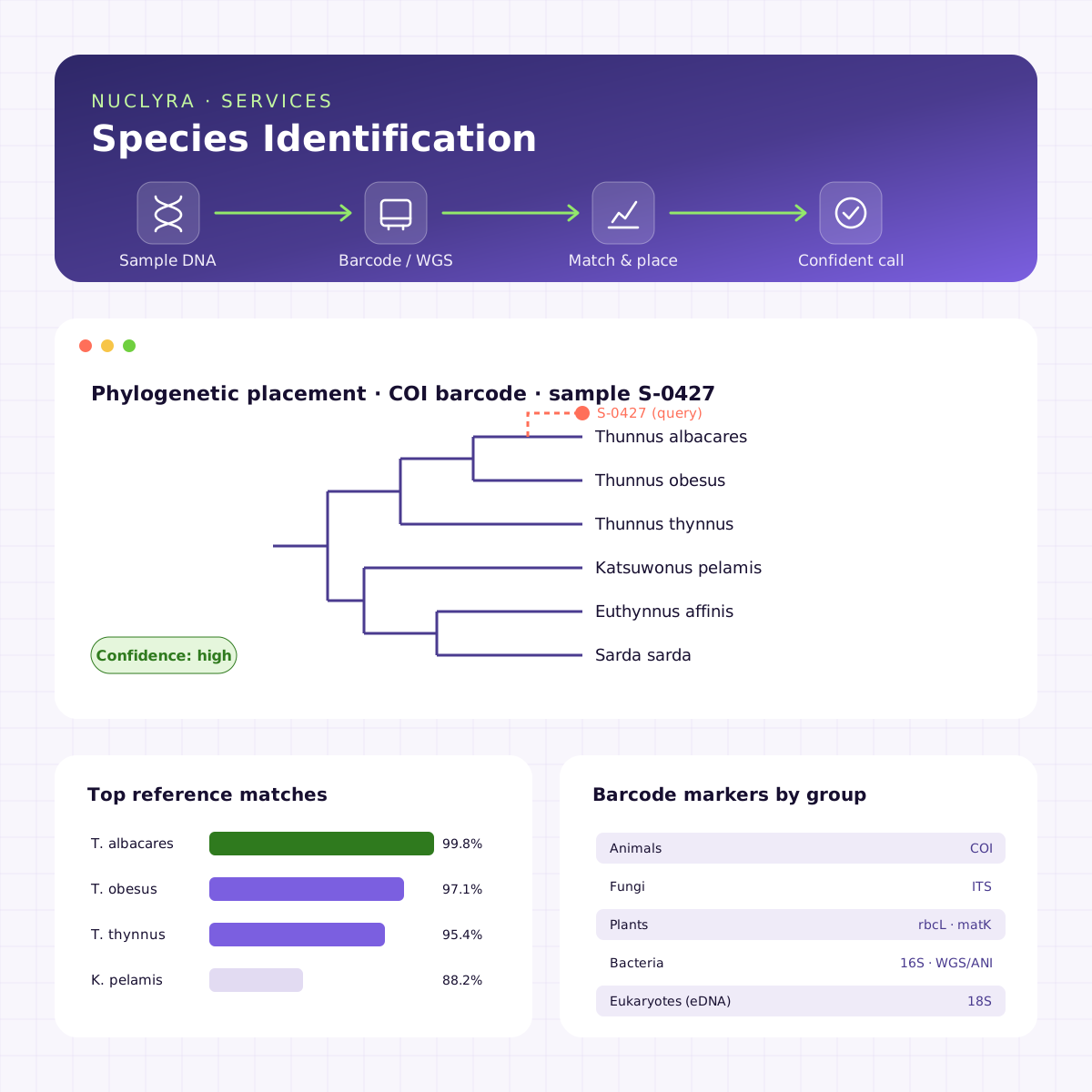
Each call reported with percent identity, coverage and runner-up matches, so ambiguous results are visible, not hidden.
Phylogenetic placement
Trees or placement against reference clades to support calls when similarity alone isn’t conclusive.
Mixture & contamination detection
Metabarcoding and read-level analysis to detect multiple species, adulterants or contaminants in one sample.
Full documentation & handoff session
Written documentation plus a recorded walkthrough so your team can operate the pipeline independently.
What this service includes
Barcoding & metabarcoding
Single-specimen and mixed-sample marker workflows from raw reads to taxonomic calls.
Whole-genome identification
ANI, MLST and genome-based taxonomy for bacteria, fungi and other isolates.
Reference curation
Versioned, cleaned reference databases built for your target taxa.
Reporting & audit trail
Confidence-scored, reproducible reports suitable for QC records and publication.
What this looks like in a real engagement
Three concrete examples of the kind of work this service covers.
Food and herbal authentication
Meat, seafood, spice or botanical products checked for substitution, adulteration and undeclared species.
Microbial isolate identification
Clinical, environmental or culture-collection isolates identified at species and strain level from whole-genome data.
eDNA biodiversity surveys
Water, soil or air samples metabarcoded to detect target, invasive or protected species across sites.
Why a top BLAST hit is not the same as an identification.
Public reference databases contain mislabelled and low-quality records, some markers can’t separate closely related species, and a sample may contain more than one organism. A pipeline that simply reports the best hit will be confidently wrong in exactly the cases that matter.
We build species identification pipelines on curated, versioned references, report confidence and runner-up matches for every call, and use phylogenetic placement or genome-wide comparison when a single marker isn’t enough.
How an engagement runs
Four stages, from sample intake to delivery.
Choose marker & references
The marker or genome approach is matched to your taxa, and reference databases are curated.
Process reads
Reads are quality-filtered, denoised or assembled depending on the method used.
Match & place
Sequences are matched against references and placed phylogenetically, with confidence scored.
Report & hand off
Confidence-scored identifications are reported, documented and handed over.
What we build it with
An identification without a confidence score is just a guess with a species name attached.
Before you reach out
It depends on the group: COI for most animals, ITS for fungi, rbcL and matK for plants, and 16S or whole-genome data for bacteria. We’ll recommend the marker that can actually separate the species you care about.
Yes. Metabarcoding detects multiple species in one sample, including in processed foods and supplements, though heavily degraded DNA may limit resolution and we report that explicitly.
Yes. We can build and version a private reference database from your vouchered specimens or isolates, alongside or instead of public databases.
Explore related work
Need to know exactly what’s in your samples?
Tell us your sample types, target organisms and how results will be used — we’ll recommend the right marker and reference strategy.