
Shotgun Metagenomics
Shotgun metagenomic pipelines that resolve taxonomic composition and functional potential straight from raw community DNA — no primer bias, no cultivation required.
TYPICAL CLIENT
A microbiome researcher who needs function, not just who’s there
Usually a microbiome researcher, environmental genomics lab or applied microbiology team who needs both taxonomic composition and functional gene content from a complex community sample — something a 16S-only approach can’t deliver.
Six concrete deliverables, not a slide deck.
This is exactly what transfers to you at the end of this Shotgun Metagenomics engagement.
QC & host-read removal
Raw reads quality-filtered and screened against a host genome (e.g. human) to remove contaminating reads before analysis.
Taxonomic profiling report
Community composition resolved to species level using k-mer and marker-gene based classification.
Functional annotation
Gene and pathway abundance profiling to characterize the community’s functional, not just taxonomic, potential.
MAG assembly & binning
Metagenome-assembled genomes recovered and binned where samples support de novo assembly.
Diversity & abundance reports
Alpha and beta diversity metrics with per-sample and per-group comparison figures.
Full documentation & handoff session
Written documentation plus a recorded walkthrough so your team can operate the pipeline independently.
What this service includes
Taxonomic profiling
Species-level community composition using Kraken2/MetaPhlAn-based classification against curated reference databases.
Functional profiling
Gene family and pathway abundance estimated with HUMAnN-based functional annotation.
Assembly & MAG binning
De novo metagenome assembly with genome binning and quality assessment for recovered MAGs.
Diversity & statistical analysis
Alpha/beta diversity and group-wise statistical comparison delivered as publication-ready figures.
What this looks like in a real engagement
Three concrete examples of the kind of work this service covers.
Gut microbiome cohort study
Stool metagenomes from a clinical cohort profiled for taxonomic shifts and functional pathway differences between groups.
Environmental / soil metagenome survey
Soil or water community samples profiled to characterize microbial diversity across an environmental gradient.
Antimicrobial resistance gene screening
A community sample screened against curated AMR gene databases to quantify resistance gene abundance.
Why shotgun sequencing answers questions 16S profiling can’t.
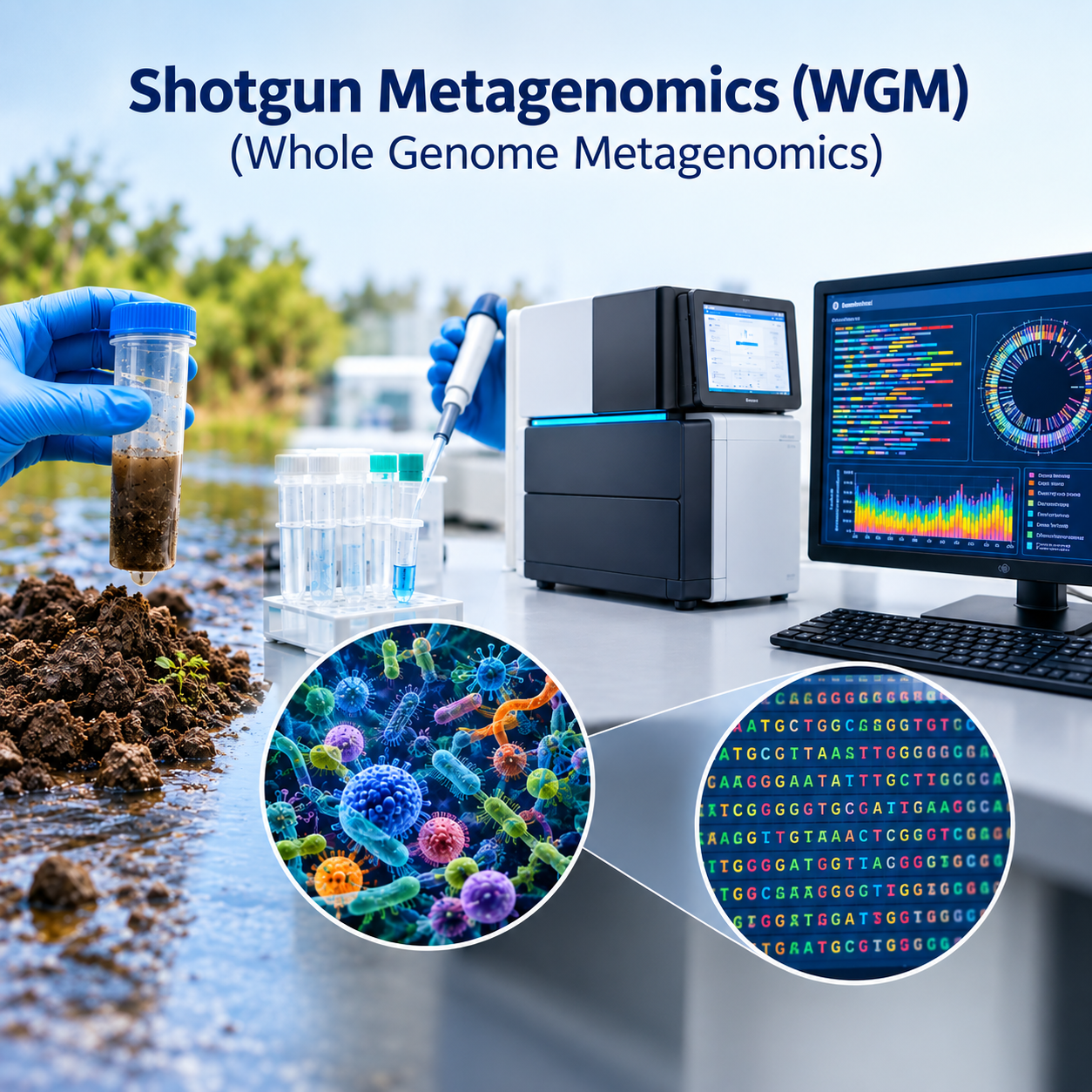
16S rRNA sequencing tells you who is likely present, at genus level, with primer bias baked in. Shotgun metagenomics sequences all the DNA in a sample, so you get species and strain-level resolution and — critically — the functional gene content that actually explains what the community is doing.
We build shotgun pipelines that pair taxonomic and functional profiling by default, with optional assembly when a sample has enough depth to recover meaningful metagenome-assembled genomes.
How an engagement runs
Four stages, from sample intake to delivery.
QC & host removal
Reads are quality-filtered and screened to remove host or contaminant sequences.
Taxonomic & functional profiling
Community composition and gene/pathway abundance are profiled in parallel.
Assembly & binning
Where depth supports it, reads are assembled and binned into draft metagenome-assembled genomes.
Diversity analysis & hand off
Diversity statistics and figures are generated, documented and delivered.
What we build it with
Knowing which species are present tells you a story; knowing what genes they carry tells you what the community is actually doing.
Before you reach out
Shotgun sequencing profiles all DNA in a sample for species/strain-level and functional resolution; 16S targets one marker gene for genus-level composition at lower cost.
Typically 5–10 million reads per sample for taxonomic and functional profiling; deeper sequencing (20M+) is recommended if MAG assembly is a goal.
Yes — AMR gene screening against curated databases is available as part of the functional annotation step.
Explore related work
ChIP Sequencing
A targeted approach for protein-DNA binding, unrelated to community composition.
View 16S16S rRNA
A faster, lower-cost alternative when genus-level composition is enough.
View BIOBioinformatics Pipeline overview
See how shotgun metagenomics fits into the full Bioinformatics Pipeline service.
ViewHave community samples waiting on a functional answer?
Send us your sample type and research question — we’ll tell you honestly whether shotgun or 16S is the right sequencing strategy.