
In Silico Drug Discovery
Molecular modeling, docking, virtual screening, and computational chemistry to accelerate early-stage target validation and candidate evaluation.
TYPICAL CLIENT
A discovery-stage biotech trying to shorten the path from target to candidate
Usually a Head of Computational Chemistry or VP of Discovery who needs to prioritize a chemical space that’s too large to test by hand, and wants modeling that holds up when it meets a wet-lab assay, not just a leaderboard.
Six concrete deliverables, not a slide deck.
This is exactly what transfers to you at the end of this In Silico Drug Discovery engagement.
Target structural analysis report
Binding-site characterization and druggability assessment for your target.
Virtual screening results, ranked
Full compound library screening results with binding affinity scores and confidence intervals.
Generative candidate set
Novel candidate structures with predicted properties, ready for medicinal chemistry review.
ADMET prediction report
Developability scoring across absorption, metabolism, toxicity and related properties.
Annotated shortlist
A prioritized shortlist with reasoning for each candidate’s inclusion, in a format your team already uses.
Reproducible screening pipeline
The full screening and scoring pipeline, so future campaigns don’t start from zero.
What this service includes
Virtual screening & docking
Structure-based screening across libraries of millions of compounds, ranked by predicted binding affinity.
Generative molecule design
Property-guided generative models propose novel candidates optimized for potency, selectivity and synthesizability.
ADMET prediction
Early-stage prediction of absorption, distribution, metabolism, excretion and toxicity to deprioritize weak candidates fast.
Target identification support
Structural biology and omics data combined to support early target identification and validation.
What this looks like in a real engagement
Three concrete examples of the kind of work this service covers.
Virtual screening a compound library against a target
Docking and scoring a large library computationally to prioritize the few hundred compounds actually worth synthesizing.
Generative design around a known scaffold
Proposing novel candidate molecules with predicted binding affinity and drug-like properties around a validated starting point.
ADMET prediction before wet-lab testing
Flagging likely toxicity, solubility or metabolism issues early, so wet-lab time is spent on candidates more likely to survive it.
Narrowing the search space before the wet lab gets involved.
Synthesizing and testing a candidate is expensive and slow. Our job is to make sure the candidates that reach the bench are the ones worth testing — not the ones that happened to come first.
We combine the principles of physics, chemistry, and biology with advanced AI to understand molecules beyond a single prediction. From molecular interactions and chemical properties to biological activity and developability, our models connect the full discovery picture to identify stronger, more actionable candidates.
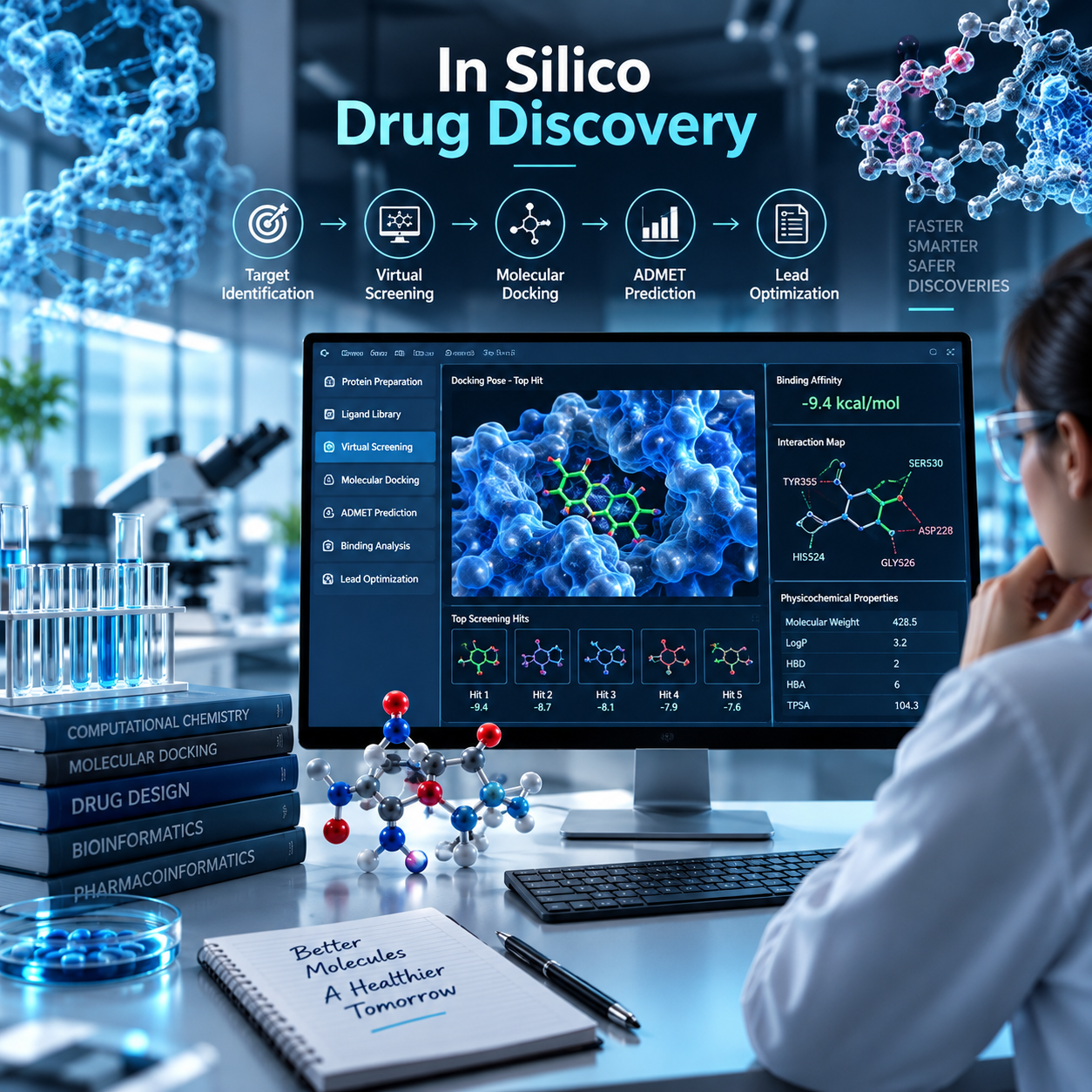
How an engagement runs
Four stages, from initial scope to delivery.
Characterize the target
Structural and binding-site analysis establishes what a viable candidate needs to satisfy.
Screen & generate
Virtual libraries are screened alongside generative design runs to widen and rank the candidate pool.
Predict developability
ADMET and selectivity prediction filters candidates before synthesis is ever considered.
Deliver a ranked shortlist
A prioritized, annotated shortlist is handed to your medicinal chemistry team.
What we build it with
Nuclyra’s shortlist matched what took our team three months to narrow down manually — in under two weeks.
Before you reach out
Yes, fully. Generated candidates, screening results and the pipeline itself all transfer to you.
We regularly screen libraries in the 1M–50M compound range; larger campaigns are scoped case by case based on target and compute budget.
Yes, we can work from a predicted structure (e.g., AlphaFold) when a crystal structure isn’t available, with appropriate caveats on confidence.
Explore related work
Have a target and a compound library?
Tell us about the target class and library size — we’ll scope a screening and design campaign.