

Research Institutions & Universities
Grant-friendly pipelines, shared compute environments and reproducible analysis for academic labs and consortia.

TYPICAL CLIENT
A principal investigator or bioinformatics core director managing a grant-funded, multi-year study
Often leading an NIH-, NSF- or foundation-funded genomics or multi-omics study, sometimes across multiple collaborating labs, and needing infrastructure delivered within a fixed grant budget and timeline.
The problems that bring teams to us.
Grant budgets that don’t fit a typical vendor retainer
Most computational vendors are structured around ongoing retainers that don’t map cleanly onto a fixed grant budget or renewal cycle.
Reproducibility standards that keep rising
Journals and funders increasingly require fully reproducible, containerized analysis, which many academic pipelines were never built to meet.
Coordinating data sharing across independent labs
Multi-institution studies need to share and jointly analyze data without any single lab losing control over its own contribution.
Four places we plug into your program.
What each of these actually looks like day to day — not just the one-line version.
Grant-aligned delivery
Academic budgets and timelines run on the grant cycle, not a typical commercial engagement schedule, and most vendors aren’t built around that reality. We structure engagements and pricing to work within grant reporting periods and funding milestones, so the work fits your funding cycle instead of fighting it.
- Engagement scoping aligned to grant periods and renewal cycles
- Pricing structures that work within academic procurement processes
- Milestone reporting formatted for grant progress reports

Multi-lab consortium support
Consortium data sharing usually stalls on the same question: how do independent labs collaborate on shared data without any one lab giving up control of its own. We build federated data platforms that let each lab keep control of its data while still enabling consortium-wide analysis.
- Federated data architecture with per-lab access and governance
- Consortium-wide query layers that respect each lab’s data-sharing terms
- Onboarding designed for labs joining a consortium mid-project

Reproducible pipelines
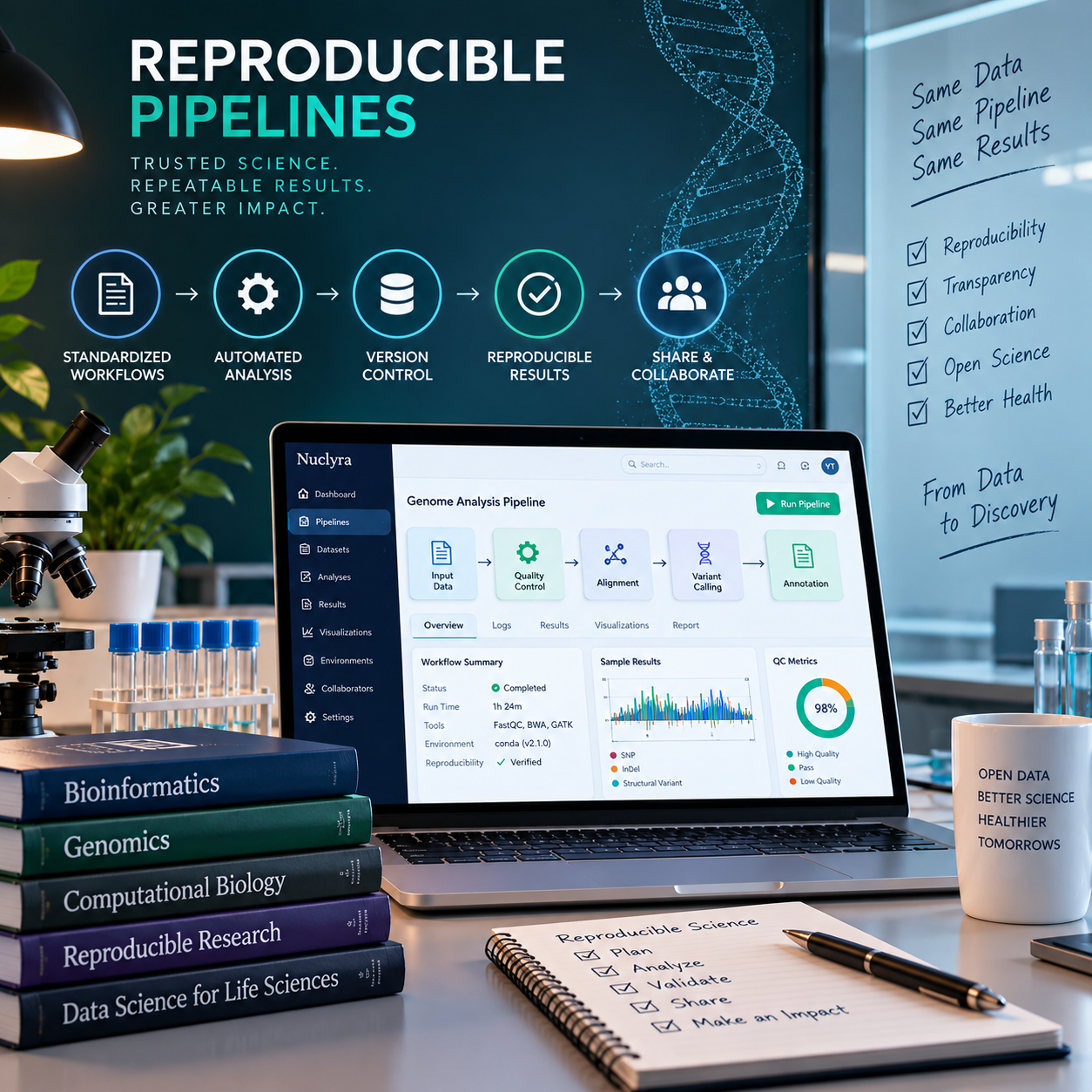
A pipeline that produces a result nobody else can reproduce doesn’t hold up to peer review, and reviewers are asking harder questions about reproducibility every year. We build pipelines to the reproducibility standard journals and funders now expect, with versioned code, environments and data lineage documented from the start.
- Containerized, version-controlled pipelines with full environment capture
- Data lineage tracked from raw input through to every published figure
- Pipelines built to meet journal and funder reproducibility requirements
Publication & grant support
Writing a methods section that accurately reflects a computational pipeline, or preparing figures a reviewer won’t push back on, takes time most labs don’t have to spare. We prepare computational methods documentation and figures to publication and grant-review standards, so that work is ready when a submission deadline is.
- Methods sections written to match your actual pipeline implementation
- Publication-ready figures generated directly from validated pipeline output
- Documentation prepared for both journal submission and grant renewal

Built around how academic research actually gets funded and published.
Academic timelines run on grant cycles and publication deadlines, not product launches. We structure engagements — and pricing — around that reality, rather than forcing a startup-style retainer onto a lab budget.
Every pipeline we deliver is also built to the reproducibility bar a peer reviewer will expect, so a paper’s computational methods hold up under scrutiny.
How we approach this field
Four stages, shaped around how this industry actually operates.
Align to the grant
We scope work against your grant’s timeline, deliverables and reporting requirements.
Deliver reproducible pipelines
Pipelines are built to withstand peer review and journal reproducibility requirements.
Support multi-lab consortia
Federated infrastructure lets partner labs collaborate without centralizing sensitive data.
Support the paper
We help prepare methods sections, figures and supplementary code for submission.
Our reviewers stopped questioning the reproducibility of our pipeline the moment we cited Nuclyra’s documentation.
Before you reach out
Yes, we regularly structure engagements and invoicing to align with grant budget categories and reporting periods.
That’s the explicit bar we build to; our pipelines are designed to satisfy the reproducibility standards journals and funders now expect.
Yes, this is a common part of the engagement — drafting or reviewing methods sections and supplementary code documentation.
Working within a grant timeline?
Tell us your funding cycle and deliverables — we’ll structure the engagement around them.